
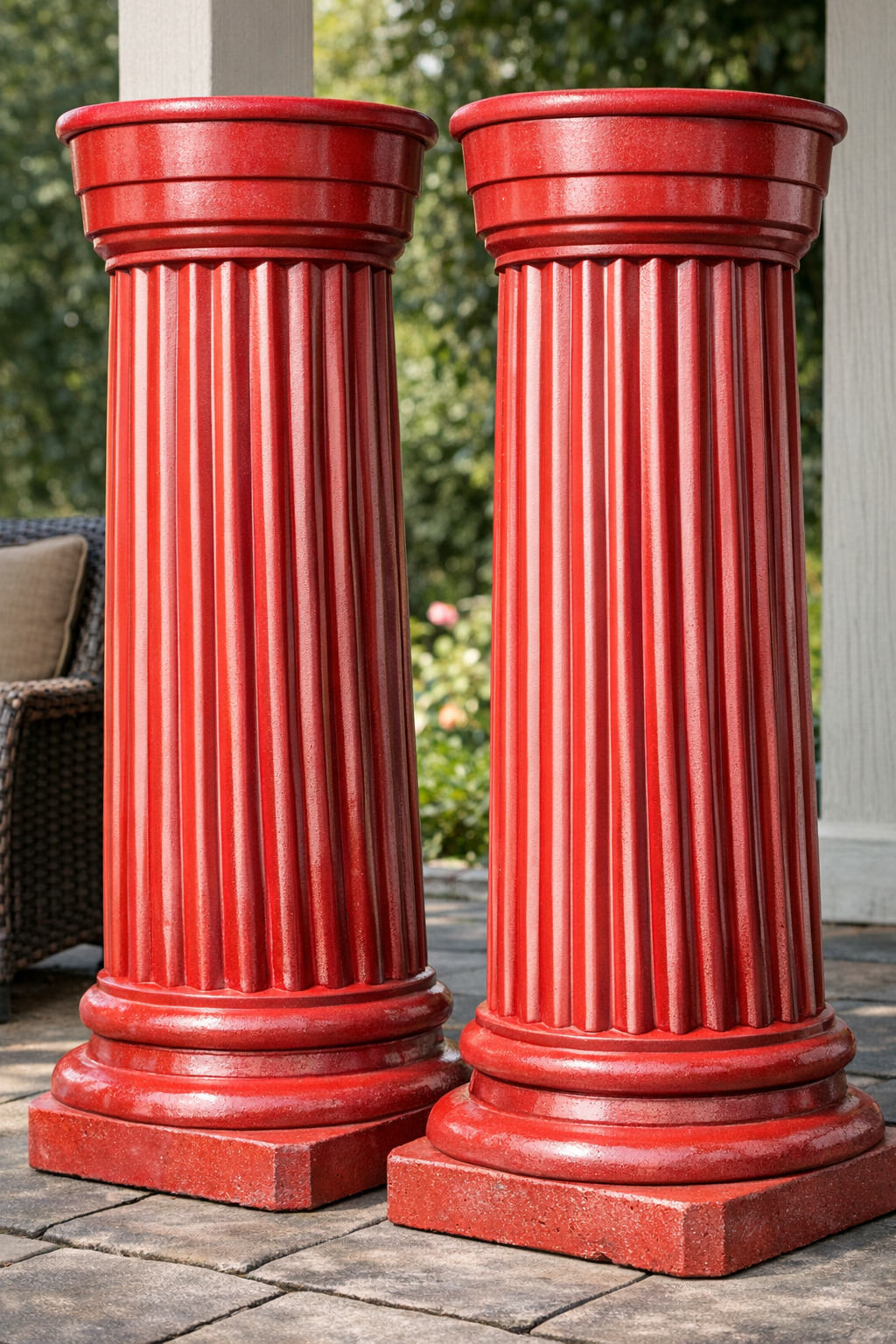
There’s a certain kind of project that feels a little like kitchen-table magic to me: humble, everyday things going in one direction, and something stately and surprisingly handsome coming out the other side. These heavy fluted outdoor columns are made with ribbed red plastic party cups and cement, and the finished look reminds me of the kinds of porch details you’d see on older Midwestern homes out in the country—simple, sturdy, and full of character.
If you want a pair of decorative outdoor columns for a porch corner, garden entry, patio backdrop, or to frame planters, this is a satisfying build that doesn’t ask for fancy molds or specialty casting supplies. The cup ribs create that fluted texture all on their own, and the cement gives the piece real weight, which I always appreciate outdoors where wind likes to have its say.

Materials
Instructions
1. Decide how tall you want each column and count out an equal number of cups for each one; about 20 cups per column gives a medium-height decorative column, while more cups makes a taller, more dramatic piece.
2. Mix a small batch of cement with water until it reaches the texture of thick oatmeal; it should be wet enough to settle into the cup ribs but stiff enough not to pour like soup.
3. Fill one cup nearly to the rim with wet cement, tapping it gently against the work surface to release trapped air and help the mix settle into the fluted sides.
4. Fill a second cup about halfway with cement, then press the full cup upside down into it so the rims meet and the two cups lock together with cement inside both halves.
5. Continue adding cups one at a time, alternating full and half-full as needed so each new cup bonds to the last and forms one continuous cement-filled stack.
6. Check the stack every few cups to keep it straight; a gentle adjustment while the cement is still wet is much easier than correcting a lean later.
7. Build the first column to the desired height, then leave it lying flat or carefully supported so it can firm up without shifting.
8. Repeat the same process for the second column, using the same number of cups so the pair matches in height and proportion.
9. Let the columns cure until the cement is fully hard; depending on weather and thickness, that usually means at least 24 to 48 hours before unmolding and longer if conditions are cool or damp.
10. Tear or cut away the plastic cups section by section once the cement is hard, peeling them off carefully to reveal the fluted surface underneath.
11. Stand the columns upright on a firm, level surface and check for any rough seams; if needed, rub away small crumbs of cement by hand once fully cured.
12. Place the finished columns beside a doorway, at the edge of a porch, or in the garden as decorative architectural accents, making sure they rest on stable ground where their weight is supported evenly.
Variations & Tips
For taller columns: Work in manageable sections if a full-length stack feels unwieldy, then join cured sections with fresh cement between them for added height.
For a cleaner texture: Tap each filled cup before stacking it into place. That little old-fashioned patience saves you from air pockets and gives sharper fluting.
For more stability: Shorter, thicker columns tend to be easier to place outdoors than very tall narrow ones. If your area gets strong wind, I’d keep the proportions stout and grounded.
For easier unmolding: Wait until the cement is fully hard but not weathered for days inside the cups. I find the plastic peels away more cleanly once the column has cured solidly and the cups have not baked onto the surface.
For a pair that looks intentional: Count every cup before you begin and mix enough cement for matching sections. Symmetry makes these look far more expensive than they are.
For outdoor longevity: Set the finished columns on pavers, stone, or concrete instead of bare soil so they stay cleaner and drier at the base. That’s an old porch trick that helps most cement pieces last better through the seasons.